Small talk works like a loop, not a script: open with an observation, ask an open-ended question, react to their answer, then either go deeper or exit gracefully. Most people freeze not because they lack personality, but because they haven't rehearsed the loop enough times for it to feel automatic. The fix is repetition in low-stakes settings before you need it for real.
If you've ever left a conversation replaying it in your head, wondering why you went blank after "how's it going," you're not bad at small talk — you're just under-rehearsed. Small talk is a skill like any other, and skills get better with reps, not willpower.
Why small talk feels harder than it should
Small talk carries an odd amount of pressure for how low-stakes it's supposed to be. Part of the problem is that most of us only "practice" it in real situations that matter — a work event, a first date, a new neighbor — where the cost of fumbling feels high. Without a safe place to rehearse, your brain never gets the reps it needs to make small talk feel automatic.
The four-part structure that actually works
1. Open with an observation, not a question
"This line is moving slowly" lands better than "How are you?" because it gives the other person something concrete to react to, rather than a generic prompt they've answered a thousand times on autopilot.
2. Ask one open-ended question
Questions that can't be answered with "yes" or "no" keep the conversation moving without you having to carry it. "What brought you here?" beats "Do you come here often?"
3. Reflect, then build
Repeat a piece of what they said back to them, then add to it. If they mention a rough week at work, "Rough week — what's been going on?" shows you were listening and hands the conversation back to them without effort.
4. Exit on a high note
Have two or three exit lines ready so you're never stuck. "It was really nice talking to you — I'm going to grab a refill" ends things warmly instead of trailing off awkwardly.
The part most advice skips: reading the structure doesn't make it automatic. You need to actually run through it — ideally more than once, ideally somewhere the stakes are zero — before it holds up under real pressure.
How to practice this with Talkville
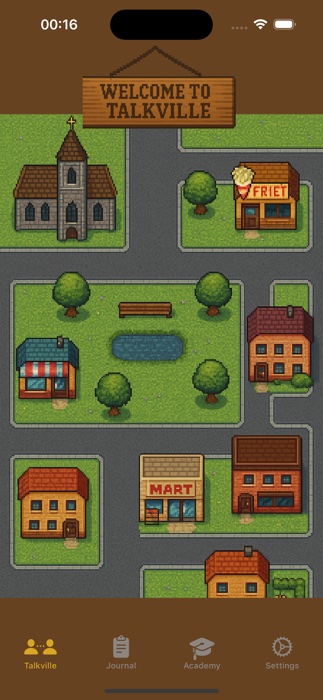
Talkville turns the structure above into an actual rehearsal instead of a reading exercise. You walk into a scenario — a shop, a bar, a waiting room — and have the real back-and-forth with an AI character who responds like a real person would, not a script.
- Pick an everyday situation that mirrors what you're actually nervous about: the fries shop, the hairdresser, a bar conversation.
- Run the loop for real — open, ask, reflect, exit — against an AI character with their own personality, so no two run-throughs feel identical.
- Get instant feedback on where the conversation stalled or where you leaned too hard on yes/no questions.
- Repeat it as many times as you want until the loop feels like muscle memory, then try it in real life.
Practice your next small talk moment tonight
Free to download. Pick a scenario and run through the loop as many times as you need.