For many autistic adults, small talk is harder because it's unscripted and full of unwritten rules. Scripting and rehearsing likely conversations in advance — the exact wording, the likely responses, the way to close things out — turns an unpredictable interaction into something familiar before it happens. An AI roleplay app can provide that script-building practice without feeling like a therapy exercise.
A lot of social skills content is written for neurotypical brains and just doesn't map cleanly onto how many autistic adults actually process social situations. What tends to help more is something concrete and repeatable: a specific situation, a specific conversation, practiced enough times that it stops requiring real-time improvisation.
Why unscripted small talk is uniquely hard
Small talk relies on a huge number of unstated conventions — how long to hold eye contact, when a topic has "run its course," how much detail is too much. For many autistic adults, navigating all of that in real time, on top of the actual content of the conversation, is the exhausting part — not a lack of things to say.
What actually helps: scripting in advance
Rehearse the specific wording
Not a vague sense of "what to talk about" — the actual sentences. Practicing exact phrasing out loud removes a layer of real-time processing from the real interaction.
Learn the likely responses
Most everyday exchanges (ordering, checking out, small talk with a coworker) only have a handful of common directions. Practicing a few of them in advance covers most real situations.
Practice at your own pace, with no one watching
Group social skills workshops can add exactly the kind of real-time social pressure that makes practice harder, not easier. Private, repeatable practice removes that pressure entirely.
Repeat until it's familiar, not until it's "mastered"
The goal isn't perfection — it's familiarity. A conversation you've run through five times feels categorically less overwhelming than one you're having cold.
Why this shouldn't feel like therapy: practice that feels clinical or effortful is harder to stick with. Framing it as a low-stakes roleplay — closer to a game than a worksheet — tends to make people actually do the reps, which is what makes the difference.
How Talkville supports this kind of practice
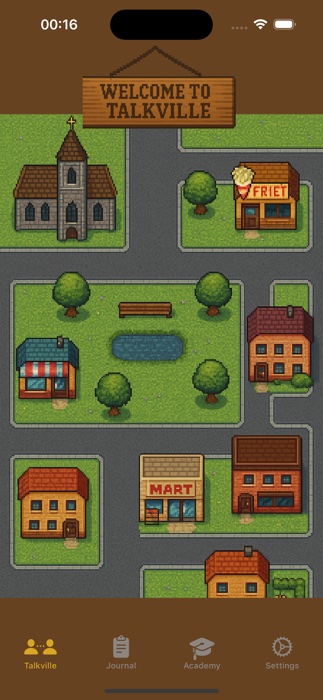
Talkville is built around exactly this: a town of specific, repeatable social scenarios, each with an AI character you can talk to as many times as you want, at your own pace, with no one else watching. It's framed as a game, not a clinical exercise — reviewers on the App Store have specifically described using it this way.
- Specific, repeatable scenarios — shop talk, neighbor chat, bar conversation — that you can rehearse until they're familiar.
- Script it first — try exact wording, see how the AI character responds, adjust and try again.
- Completely private — no group setting, no one watching, no time pressure.
- Track your progress in the Social Journal to see which scenarios you've already built familiarity with.
Script your next conversation before you need it
Free to download on iPhone. Practice at your own pace, with zero pressure.